It Just Has To Be Delicious

Archive for June, 2020

Mushroom, Onion and Tomato Tart
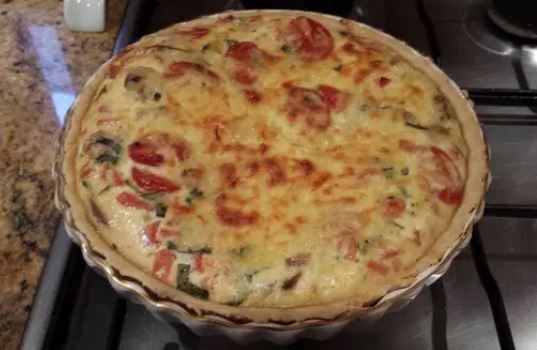
tart

I wanted to make a tart for our special lunch at work, and decided to make
something vegetarian so that everybody could have a taste. I made the pastry the day before and lined the pie dish with it. I then kept the pie dish in the fridge until I needed it.

PASTRY:
250g plain flour
125g butter (or 100g dairy free spread), diced
1 egg
pinch of salt

1. Mix the flour, salt and butter in a food processor until the mixture resembles fine breadcrumbs.
2. Transfer to a large bowl and add the egg. Mix well with a spatula.
3. Add splashes of cold water until it binds together to form a nice round of dough.
4. Making sure that your hands are cold, pat the dough together and roll out on a floured surface. Line a pastry dish with the dough and hook it over the edge of the dish slightly (this will stop it from shrinking down in the oven). Wrap the whole dish in foil and store in the fridge until needed.
On the day that you are cooking the tart, bake the pastry case blind (use ceramic beads) for approx 10 – 15 minutes at 180 deg C. Once baked blind, gently press a rolling pin on the top edge to remove the excess pastry that was hooked over the sides.

FILLING:
You can use your imagination with the filling and include any veggies that you like, but I chose onion, mushroom and tomatoes.
ONIONS – Slice 1 large or 2 small onions (I used red onions), and fry them in a little olive oil. As they soften add a sprinkle of salt, a dash of balsamic vinegar (optional) and a little sugar (optional) to help them caramelise.
MUSHROOMS – Slice the mushrooms and cook them in a saucepan with a little salt and pepper and a teaspoon of dairy free spread or butter until they are just soft.
TOMATOES – I used cherry tomatoes halved and I cooked them – cut side down – in the onion pan just to concentrate some of the liquid in them. You can also add some chopped sun dried tomatoes to the tart. I seasoned them lightly with salt and pepper.
BASIL – tear or thinly slice some fresh basil leaves
SAUCE – 3 eggs whisked up with 280mls milk and some grated cheddar – I don’t know how much I used but it was probably enough to cover the surface of the tart. I mixed some cheese with the sauce and saved some to sprinkle on top.
Now arrange the onions, mushrooms and tomatoes in the tart, add some chopped basil, and pour the sauce over to fill the tart to the brim, Sprinkle a little cheese on top and bake in a preheated oven at 180-200 deg C for approx 25-30 minutes until the filling is set and golden.
Serve warm or chilled.
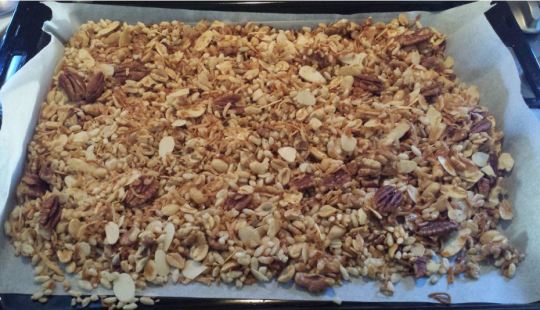
Granola

granola

Do you know exactly what goes into your breakfast cereal ? The regular supermarket cereals tend to be full of sugar and additives, and the more sophisticated cereals are expensive for what you get.
Making your own granola is easy and cheaper. You get exactly what you want and it tastes great with yoghurt and berries on top. It’s portable – you can put some granola, yoghurt and berries in a jar and take them into work for an easy desk breakfast. I have a long journey so I pop some frozen berries on top (cherries, blueberries) and by the time I get to work the berries have thawed.

Start by lining an oven tray with baking parchment and set your oven to approx 150 deg C.

Now the fun bit – you can make it up as you go along. If you are allergic to nuts, leave the nuts out, if you are allergic to oats, leave the oats out. Choose from any of the following, but don’t add any chocolate chips or dried fruit at this stage because they will melt and burn.

You just need nuts seeds and grains at this time. Generally, oats form the major part of the base, but if you are allergic to oats try something different like plain puffed rice. Grab a large bowl and get mixing – I generally use the following:
Porridge oats (steel cut) 1-2 cups
Puffed rice with no added sugar 1-2 cups
As much as you fancy of:
sunflower seeds
pumpkin seeds (pepitas)
pine nuts
chia seeds
flax seeds
sliced almonds
shredded coconut
peanuts
walnuts
pistachios
hazelnuts
pecans
This is just a guide – you can use any nuts and seeds that you like

Stir through some coconut oil and honey (approx 4 tablespoons)
Spread it all out on the baking parchment – the thinner the layer, the quicker it will toast – and stir through every ten minutes. It should take about 30 minutes to toast nicely, and it will be a lovely golden colour. Leave to cool.
Now you can transfer it to a plastic cereal container but beforehand you can stir through any of the following, or you can add them each time you get your breakfast ready depending on how you feel.
Chop them or leave them whole :
plump dried apricots
prunes
dried peel
sultanas
craisins
cranberries
dried banana chips
dried figs
dark chocolate nibs
When you serve your granola, use a luscious thick greek style yoghurt like Gippsland (greek yoghurt has good protein content) or alternatively use ricotta cheese, marscapone, or soy/coconut yoghurt.
Top with fruit compote (really easy to make with frozen berries – just put some in a saucepan with a splash of water and a spoon of honey or sugar and heat gently for 5minutes), or use tinned fruits, or fresh fruits like pineapple, peaches, strawberries and banana. A yummy good quality breakfast.

gran 2

Chocolate Ginger Cookies

gcc 1

This recipe is based on my peanut butter and chocolate chip cookies, they really are simple to make and taste very good. The ginger chunks add a nice dimension and they are based on my memories of M&S extremely chocolatey biscuits. You just need a food mixer, a hand held one is fine, and the ingredients are really straightforward.

Start off by lining a few baking trays with baking parchment – you will need 2 large or 3 small baking trays.

Set the oven to 190 deg C.

Ingredients
180g plain flour
half a teaspoon of baking powder
a pinch of salt
150g butter or dairy free spread e.g. Nuttelex
60g soft brown sugar (you can also use caster but brown sugar adds gooeyness)
1 teaspoon of vanilla essence
1 large egg
125g of chopped crystallised ginger (or the uncrystallised naked ginger works well) I use Buderim ginger, but please don’t use raw ginger – it’s not the same!
Optional: you can also include a handful of chocolate chips to the dry mix and a scoop of Nutella or peanut butter to the wet mix if you want an extra richness

For the coating – approx 200g chocolate of your choice – I like dark 70-80% cocoa

Method
1. Mix the dry ingredients together in a bowl – flour, baking soda and salt. Add the ginger chunks (and choc chips if using them). Stir well.
2. Beat the sugar and butter together using the food mixer. If including a scoop of peanut butter or Nutella, wait until it is nicely combined and fluffy then add the Nutella/peanut butter and whisk again.
3. Now beat in the egg and vanilla, it may curdle a little but don’t worry the flour will sort that out.
4. Now mix in the dry ingredients and beat again – the dough should stiffen up quite a bit and you may need to add a little water to soften it, but don’t add too much because it needs to hold together on the baking tray. It should be a kind of plasticine consistency so that you can shape it into balls.
5. Now take a dessert spoon of mixture and roll it into a ball. If it sticks to your hands, just wet your hands a little. Put all of the balls on the baking trays to make sure that they are roughly equal in size, then press them either with fingers or the base of a glass, squashing them into round biscuit shapes. Keep a few centimetres distance between each biscuit because they will spread out. You should get around 12-14 cookies.
6. Bake for approx 12-15 minutes until they are slightly golden and still a little soft in the middle.
7. Once they are cool, melt the chocolate over a double boiler (or in a bowl over a saucepan of gently simmering water – if you do this the bowl must fit tightly and not touch the water).
8. Either pour some of the melted chocolate over the biscuits or dip them half into the molten chocolate, then place on baking parchment to set. Put them in the fridge to speed up the setting. Don’t forget to taste one just to check they are ready.

Peanut Butter and Chocolate Cookies

pcc

These cookies are so simple to make and taste really good. You just need a food mixer, a hand held one is fine, and the ingredients are really straightforward.
Start off by lining a few baking trays with baking parchment – you will need 2 large or 3 small baking trays.

Set the oven to 190 deg C.
Ingredients
180g plain flour
half a teaspoon of baking powder
a pinch of salt
125g butter or dairy free spread e.g. Nuttelex
60g soft brown sugar
125g smooth peanut butter
1 teaspoon of vanilla essence
1 large egg
125g of dark chocolate either use chips or block chocolate broken into small pieces

Method
1. Mix the dry ingredients together in a bowl – flour, baking soda and salt.
2. Beat the sugar and butter together using the food mixer, once it is nicely combined and fluffy add the peanut butter and whisk again.
3. Now beat in the egg and vanilla, it may curdle a little but don’t worry the flour will sort that out.
4. Now mix in the dry ingredients and beat again – the dough should stiffen up quite a bit and you may need to add a little water to soften it, but don’t add too much because it needs to hold together on the baking tray.
5. Lastly stir in the chocolate chips.
6. Now take a dessert spoon of mixture and press it onto the baking tray in a roundish shape. Continue until all of the mixture is used up. Keep a few centimetres distance between each biscuit because they will spread out.
7. Bake for approx 12 minutes until they are slightly golden and still a little soft in the middle. It is important to taste one just to check.
8. Yum, now get the kettle on – there’s nothing like freshly baked biscuits with a cuppa.

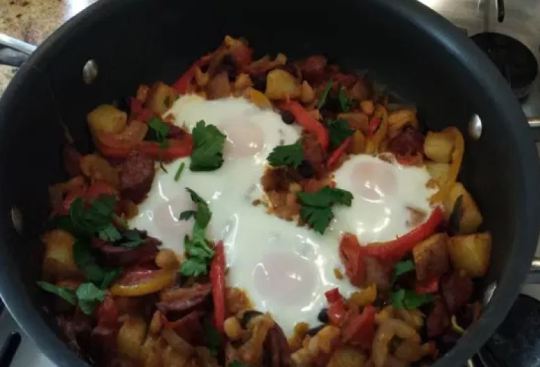
Huevos Rancheros

This is my recipe for huevos rancheros. I am not sure if it is totally authentic, but it is very tasty and works well as breakfast, brunch or supper.

huevos

This is a recipe that can be adapted to be suitable for vegetarians.
If you are vegetarian, leave the chorizos out, and if you are vegan leave the eggs out.

Ingredients:
4 fresh eggs
1 – 2 chorizos sliced or diced
2 medium potatoes
1 – 2 onions sliced
1 -2 fresh chillies sliced (any variety depending on how hot you like them)
2 cloves of garlic chopped finely or crushed
2 capsicums, one red, one yellow sliced
2 fresh ripe tomatoes chopped (Roma are good)
1 tin of mixed beans, drained (pinto beans and black beans are traditional but you can use any bean mixture)
1 tin of diced or crushed tomatoes
Thyme – fresh or concentrate
Flat leaf parsley
Smoked paprika
Salt and pepper

Method:
1. Wash the outside of the potatoes and dice them (leave the skin on – it is full of goodness and life is too short to peel potatoes). Boil them in salted water for about 10 minutes until they are soft but still holding their shape. This can be done a day in advance and if you like a crispier texture, the potatoes can then be fried or oven baked to add a bit of crunch, however, if you don’t have time the recipe still works with just boiled diced potatoes.
2. Choose a pan that is suitable for the hob and the grill (one with a handle that won’t melt) and put a little olive oil in the pan.
3. If using chorizos, put them in first to render the fat from them and add flavour to the oil. Fry them for a few minutes.
4. Add the garlic, onion, chilli, potatoes, capsicums, approx. 1 teaspoon of smoked paprika and 2 tablespoons of thyme and fry for approx. 5 minutes until the onion and capsicums have softened.
5. Add the beans and the tinned and fresh tomatoes and stir well, cook for a further 2 – 3 minutes. Turn the grill on.
6. Taste the mixture and add salt and pepper to your taste. Stir in some chopped flat leaf parsley.
7. Now make 4 wells in the mixture and break an egg in to each well. Cook for another minute on the hob and then transfer to the grill to finish off the eggs. I like my eggs to be slightly wobbly and dippy, but if you prefer your eggs well done, cook them for longer. Garnish with a little parsley.
8. Traditionally this is served on corn tortillas, but I like to serve it with crusty bread to mop up all of the sauce.

Gwen McDonald’s Stuffing

stuf

This stuffing is so tasty, it’s like a meal in itself. It’s our much cherished recipe that my mother in law used to make. You can have it the traditional way with roast chicken or turkey, and I can guarantee that it will taste excellent the next day in leftover chicken and stuffing sandwiches. I have a friend who likes to eat it inside yorkshire puddings mixed with chicken and mayo. When you bake it, the receptacle that you bake it in depends on your preference – if you like your stuffing in big meaty slices (meatloaf style), bake it in a 1 or 2 pint pudding dish, if you like your stuffing crispy, lay it out more thinly on a greased flat baking tray, or use something in between the two – your choice. It needs baking for approximately 40 minutes at 170-180 deg C, but if you spread it more thinly it will need less time, maybe 30 minutes. The quantities are very rough too because it is a home grown recipe. You can add extra ingredients if you like, or take away ingredients that you don’t like to suit your taste.

These are the rough quantities that I use:

1 medium onion diced

2 large flat mushrooms chopped into small pieces

3-4 rashers of bacon chopped into small pieces

85g packet of Paxo Sage and Onion stuffing mixed up with water as directed OR 2 slices of bread, a few sage leaves and a few sprigs of thyme

1 packet of 8 pork sausages or the equivalent amount of sausagemeat (I prefer British sausages, so use the ones from the ‘British Sausage Company’ – my English friends can use their favourites such as Walls or Butcher’s Choice)

1. Fry the onion, mushrooms and bacon in a little oil until almost cooked. Cool for 5 minutes.
2. If you haven’t got Paxo ready and made up, whizz up the bread in a food processor to get breadcrumbs, and add some chopped sage and thyme (avoid the thyme stalks, just use the leaves).
3. Place the sausagemeat in a large bowl. If you are using sausages, remove the skins by running a sharp knife along one edge and separating the skin from the meat.
4. Mix all of the other ingredients together with the sausagemeat – use a wooden spoon or your hands to combine everything thoroughly.
5. Butter or lightly grease your receptacle of choice and bake in an oven as directed above.

stuf 2

Terrine

I had a party this weekend and decided to make terrine for the food table. I thought it would be difficult and take ages, but it was surprisingly easy and it turned out really well.

ter 1

I discovered that you can really make it up as you go along, you can use pretty much whichever meats you like, and you can also add herbs that you like. If I were to make this again I might add some vegetables to it for a change of texture.
I made the terrine from the recipe on the BBC Good Food page but adapted it by adding chicken. I found that the quantities were enough to make one full sized terrine and one smaller one. I used standard loaf tins to make it.

Ingredients
300g pork tenderloin
2 medium sized chicken breasts
2 packs of sausages or an equivalent amount of sausagemeat (if using sausages, remove the skins)
a bunch each of thyme, parsley and chives, finely chopped
approx 12 rashers of streaky bacon (or use long cut bacon and save the meaty part for brekkie)
a splash or two of port or brandy
100g pistachios – shelled
a bag of dried apricots (or you could use prunes or sour cherries)

1. Chop the pork tenderloin and chicken into bite sized pieces and soak in the brandy for a while – just use a few tablespoons of brandy and stir it occasionally. Add a little salt but not too much because the bacon and sausages will add salt.
2. Heat the oven to 180 deg C.
3. Lightly butter two standard loaf tins.
4. Line the tins with the streaky bacon, try not to leave any gaps. If found that my rashers were too short to wrap right around the terrine but it still worked out ok.
5. Sprinkle some of the mixed herbs on the bacon, then line the bottom with pork fillet.
6. Sprinkle with more herbs and some pistachios – you can actually use quite a few pistachios, I was a bit sparing with mine.
7. Layer some sausagemeat on top, sprinkle with herbs again, and place a line of apricots down the middle.
8. Now layer with chicken, add more herbs, and finish with another layer of sausagemeat.
9. If there are any ingredients left just tuck them in where you can – you can do another layer of apricots or pistachios if you like.
10. Wrap the bacon over the top of the terrine and squash it down firmly – I covered it with foil and pushed the foil down quite hard with my hands.
11. Wrap the loaf tins in heavy duty foil, use a few layers and wrap them tightly.
12. Half fill a roasting tray with hot water to make a bain marie, and place the loaf tins in the water. Don’t overfill the roasting tin, the water mustn’t get into the terrines. My water level was approx two thirds the height of the tins.
13. Place the roasting tin containing the terrines into the oven and cook for 1 to one and a half hours.
You can test them with a skewer or a meat thermometer to see if they are done.
14. Take the terrines out of the water bath and let them cool completely. While they are cooling place a few large cans on top to weigh down the meat. This will give you a more tightly packed result.
15. Now transfer then to the fridge – still weighed down and leave overnight.
16. My terrines kept ok in the fridge for a few days before serving. When you turn them out, run a knife around the outside of the bacon, tip them over and tap the tin. The surface will be covered in a thin layer of meat jelly which is quite nice.

ter 2

Samosas

I love samosas. This is a vegetarian recipe, but you can add minced lamb to the mixture if you prefer the meat version. I made mine with filo pastry – you can make the traditional samosa pastry if you like, but it is quite an art to get it right, and filo crisps up really well when you fry them. I asked my Indian friend Kesh if it is ok to use filo and he said yes, so if it’s good enough for him then I don’t feel too bad about cheating. Like the onion bhajias, you can fry these in advance and heat them up later in a hot oven.

sam 3

To make the filling you need:
2 onions chopped
4 medium potatoes diced small
2 carrots diced small
2 cups of frozen peas
1 teaspoon of salt
2 teaspoons of green masala paste (if you haven’t got any – whizz up a green chilli with 2 large cloves of garlic and and inch of root ginger)
1 teaspoon of grated fresh ginger
1 and a half teaspoons fresh crushed garlic
2 teaspoons sugar
half a teaspoon turmeric (haldi)
half a tablespoon ground coriander (dhania)
half a tablespoon ground cumin (jeera)
2 tablespoons lemon juice
a large handful of coriander leaves finely chopped

Method
1. Heat 3 tablespoons of sunflower or groundnut oil in a large pan or wok with a lid
2. Add the onions and fry gently for a few minutes, then add the rest of the ingredients and mix well.

sam 4

3. Cover and simmer over a low heat for up to 45 minutes (the cooking time will depend on how large the pieces are).
4. Test regularly with a knife to see if cooked (try a potato).
5. Stir through some butter or non dairy spread while still warm, and then set aside to cool. Next step you need butter or non dairy spread and some cornflour.
6. Melt some butter or non dairy spread to brush on the pastry.
7. Mix 1 teaspoon of cornflour with water to make a runny paste – this can be used to ‘glue’ the filo edges together if the samosas are a bit loose.

Once the filling has cooled, spread out some filo pastry on a work surface.
Take one sheet and brush it with the butter or dairy free spread and place another sheet over the top.
Slice the sheet vertically into approx 5 strips.
At the bottom of a strip place a spoonful of filling. Fold the corner over in a triangle, then back again in a zig zag pattern until the whole strip of pastry has been used. Seal the end with a dab of the cornflour paste.
Click here for a folding diagram.
Carry on until all of the filo and mixture is used up.
Deep fry in hot oil until brown and crispy. Drain on kitchen paper.
If not eating immediately they can be finished in a hot oven for 10 minutes.

Onion Bhajias

These little onion bhajias are magic – I think it’s nice to make them small because they end up crispier and not at all stodgy. If you are not eating them straight away, you can deep fry them in advance, and then finish them off in a hot oven which will crisp them up nicely.

ob 1

What you need depends on how many you are going to make – I managed to get around 25- 30 small ones out of this mixture.
Ingredients
1/2 cup of chick pea flour (chana flour or gram flour)
1 cup of self raising flour
2 onions halved and then sliced finely so that you get long bits which will crisp up
1/4 teaspoon turmeric (haldi)
1 teaspoon salt
1 teaspoon ground cumin (jeera)
1 teaspoon ground coriander (dhania)
1/4 teaspoon crushed star anise (soomph)
1/4 teaspoon chilli powder
1 teaspoon of green masala paste (if you don’t have this whizz up half a green chilli, a large clove of garlic and 1/2″ root ginger)
200ml water

Method
1. Mix all of the dry ingredients together in a bowl, then add the water to make a batter and mix till smooth (you can use a blender if you like), then add the onions and mix well.
2. Heat some oil in a large pan or deep fat fryer – it will be hot enough when a tiny drop of batter fizzes and rises to the surface.
3. Using two spoons press the batter into small balls – it will look like it wants to fall apart, but when you add it to the oil it will bind together and be ok.
4. Use tongs to fry until golden brown on both sides, flipping every minute.

ob 4

5. Drain on kitchen paper.
6. Either eat immediately or warm up later in a hot oven for about 10 minutes.
You can make a mint sauce to dip these in by whizzing up the following ingredients:
Yoghurt (you can also use coconut yoghurt), salt, fresh mint, fresh coriander, pinch of garam masala.

ob 3
ob 2

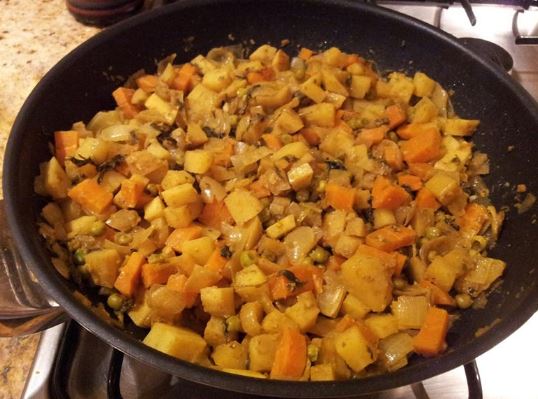
Indian Mixed Vegetables

This is my general recipe for indian mixed vegetables – it is basically an aloo gobi (potato and cauliflower) recipe which you can adapt to suit your taste and to suit whatever you have in the cupboard.
It helps if you have green masala paste and dhania/jeera spice mix already made up, but don’t worry if not – you can adapt the recipe for a one-off version, but if you find that you are making it regularly, I would advise making up a batch of each to save time.
See my page on home made Indian food for instructions on dhania/jeera and green masala.

ag 1

Aloo gobi

Here is the recipe for my aloo gobi, but feel free to change the vegetable content (carrots, broccoli, swede, spinach, capsicum, butter beans etc) – I would recommend always having potato and onion in it, but you can use sweet potato if you prefer. If you like a good variety of veg, you can make it with frozen diced mixed vegetables too.

Ingredients
1 teaspoon mustard seeds
1 teaspoon cumin seeds
2-4 tablespoons vegetable oil
1 medium to large onion – chop half of it finely and the other half quite chunky
1 -2 potatoes (or sweet potatoes) diced
half a cauliflower cut into bite sized pieces
2 ripe tomatoes chopped (skin them too if you are fussy)
2-3 large mushrooms sliced
1 tablespoon of dhania jeera mix (alternatively use a heaped half tablespoon of ground coriander and a heaped quarter tablespoon of ground cumin)
half a tablespoon of ground turmeric
2 teaspoons of green masala (alternatively grate a green chilli, 2cm ginger and 2 cloves garlic)
1-2 teaspoons sugar
half to one teaspoon salt (depending on taste)
a handful of frozen peas
a handful of fresh chopped coriander

Method:
1. Prepare all of the veg.
2. The amount of oil you need can vary depending in how many veggies you have and how watery they are – if you are not using tomatoes or mushrooms, add a little extra oil. Heat the oil in a large pan (use a huge saucepan or wok, but make sure it has a lid).
3. When the oil is hot add the cumin seeds and mustard seeds – fry until they pop and crackle.
4. Now add everything else except the peas and coriander. I find it easier to stir the spices and masala paste into the oil, then add the veggies. You won’t coat them all in spice to start with, leave them to reduce a bit and stir occasionally. Put the lid on throughout the cooking. If the veggies seem to be sticking a bit you can add a splash of water to help steam them, but don’t add too much water.
5. The veggies will take approx 30 minutes depending on how many hard veg you have. Stir them every 5 minutes and test them with a knife. When nearly done, add the frozen peas and coriander and cook for another 4-5 minutes. Taste and adjust the seasoning.
6. Serve as a veggie curry on it’s own, or as a side dish, or in Indian bread with yoghurt.
Add fresh shopped chilli if you like it hotter. If it’s too hot, add a little extra sugar and stir it in well.